Osama bin Laden – Founder of al-Qaeda
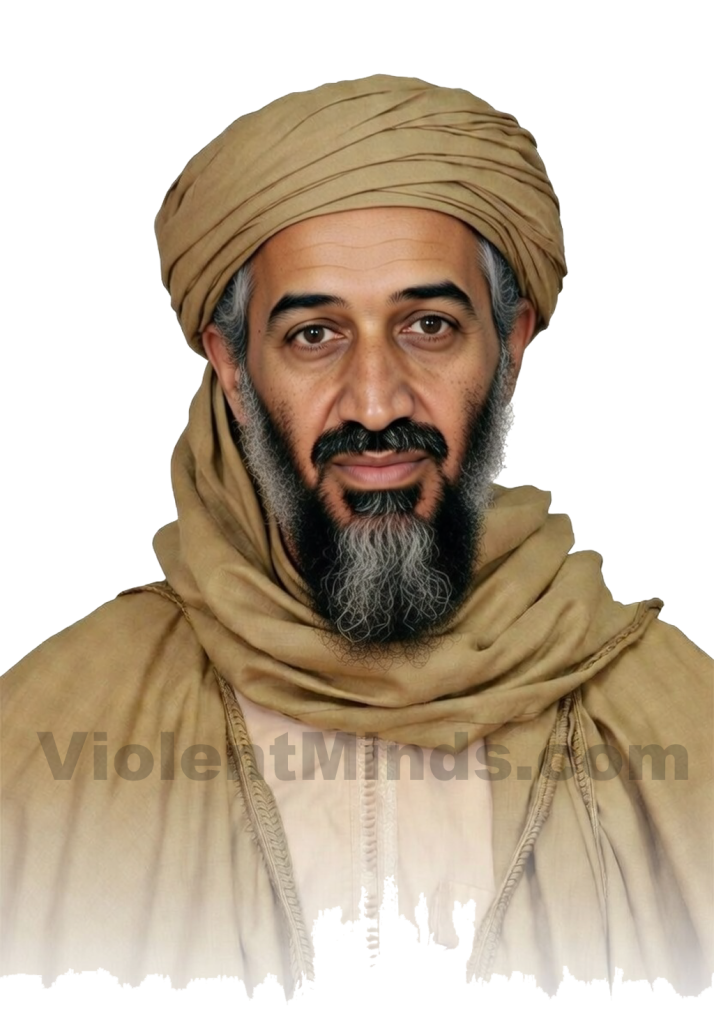
Introduction
Osama bin Laden is the Saudi-born jihadist who transformed from a wealthy construction heir into the founder and emir of al-Qaeda, orchestrating a campaign of global terrorism that culminated in the 9/11 attacks on the United States. For over two decades he functioned as both strategist and symbol: financing and guiding militant networks from Afghanistan and Pakistan, issuing fatwas that framed civilians as legitimate targets, and inspiring a generation of Salafi-jihadist groups that outlived him. On May 1–2, 2011, U.S. SEALs killed him in a nighttime raid on his compound in Abbottabad, Pakistan, ending the most intensive manhunt of the post–Cold War era.
Early Life and Formation
Osama bin Mohammed bin Awad bin Laden was born in Riyadh on March 10, 1957, into the vast bin Laden clan, the 17th child of Yemeni-born construction magnate Mohammed bin Laden and his Syrian wife, Alia Ghanem. Mohammed’s company, the Saudi Binladin Group, held lucrative royal construction contracts, making the family one of the wealthiest in the kingdom and placing young Osama in close orbit of the House of Saud’s power and religious establishment.
He grew up mainly in Jeddah, in comfortable compounds and attending elite schools, but with a distant father who managed dozens of wives and dozens of children more like a patriarchal corporation than an intimate family. Mohammed died in a helicopter crash in 1967, when Osama was about ten, leaving him with a share of an enormous fortune and a legacy of reverence for authority blended with a sense of being one among many heirs.
In adolescence and early adulthood, bin Laden gravitated toward religious conservatism. At King Abdulaziz University in Jeddah in the 1970s, he formally studied economics and public administration but informally absorbed Islamist thought through professors and preachers influenced by the Muslim Brotherhood and Sayyid Qutb’s writings. These networks emphasized the moral decay of Muslim societies, the illegitimacy of “un-Islamic” regimes, and the necessity of jihad to restore God’s order, giving bin Laden an ideological lens through which to interpret both personal and global events.
Afghan Jihad and the Birth of al‑Qaeda
The Soviet invasion of Afghanistan in 1979 provided bin Laden with a concrete theater for jihad. He began traveling to Peshawar, Pakistan, and into Afghanistan, using his wealth and connections to support the mujahideen. Initially more financier and logistics man than frontline commander, he funded guesthouses, built roads and dug tunnels, and helped set up training camps for Arab volunteers. His construction background and access to machinery made him useful, while his willingness to live roughly in the field earned him respect among some Afghan fighters.
During the 1980s, the “Afghan Arabs” – foreign volunteers from across the Muslim world – coalesced around a narrative that they were a vanguard of transnational jihad, not merely auxiliaries in a local war. In 1988, as the Soviet withdrawal loomed, bin Laden and close associates, including Abdullah Azzam and others, formalized a core of these networks into al‑Qaeda al‑Askariya (“the military base”), envisioning it as both a database of fighters and an infrastructure for future operations beyond Afghanistan. This step marks the pivot from ad hoc resistance to a structured, if diffuse, militant organization with global ambitions and bin Laden at its financial and symbolic center.
Break with Saudi Arabia and Globalization of Jihad
After the Soviets withdrew, bin Laden returned to Saudi Arabia as a minor war hero in Islamist circles, giving lectures about jihad and the Afghan experience. The 1990 Iraqi invasion of Kuwait and subsequent Gulf War became his personal and ideological rupture point. He offered to mobilize his Afghan veteran network to defend the kingdom, only to see the Saudi monarchy invite U.S. and other Western troops onto Saudi soil instead.
He interpreted this as profound apostasy: the guardians of Mecca and Medina had, in his eyes, allowed “infidel” armies into Islam’s holiest land. His criticism of the royal family intensified; Saudi intelligence monitored him, restricted his activities, and eventually maneuvered him out of the kingdom.
In 1991 he relocated to Sudan at the invitation of Islamist leader Hassan al-Turabi. There, he invested in agriculture and construction, but also built training camps and hosted militants, knitting together veterans of Afghanistan and newer recruits from North Africa and the Middle East. Under U.S. and regional pressure over his alleged role in supporting attacks, Sudan expelled him in 1996, pushing him back to Afghanistan, then under Taliban control, where he found a more permissive sanctuary.
In this exile period he crystallized his ideology in public declarations. In 1996 he issued a “Declaration of War against the Americans Occupying the Land of the Two Holy Places,” framing U.S. troops in Saudi Arabia and U.S. policy in the region as an existential threat to Islam. In 1998, he co-signed a fatwa under the banner of the “World Islamic Front” calling for the killing of Americans and their allies, “civilian and military,” wherever found – an explicit embrace of mass-casualty terrorism as religious obligation.
Al‑Qaeda Operations and Path to 9/11
From his Afghan bases under Taliban protection, bin Laden presided over a loose but increasingly ambitious network. Training camps near Khost, Jalalabad, and Kandahar hosted recruits who were indoctrinated in his worldview and taught weapons, explosives, and tradecraft. He acted as arbiter and funder of plots, sometimes providing seed money and expertise to allied groups rather than micromanaging every operation.
Key attacks associated with his leadership include:
- The 1993 Battle of Mogadishu support role, where al‑Qaeda operatives allegedly aided Somali militants who downed U.S. helicopters.
- The 1998 U.S. embassy bombings in Nairobi and Dar es Salaam, which killed 224 and wounded thousands, marking al‑Qaeda’s shift to large-scale anti-American attacks.
- The October 2000 suicide bombing of the USS Cole in Aden harbor, killing 17 U.S. sailors.
These operations demonstrated a pattern: high symbolic value targets, meticulous planning, willingness to kill civilians, and coordinated suicide attackers.
The 9/11 plot emerged from this evolution. Conceptualized largely by Khalid Sheikh Mohammed and adopted by bin Laden, it involved selecting and training hijackers, embedding them in flight schools in the West, and coordinating simultaneous hijackings to maximize shock. Bin Laden provided strategic approval, funding, and political framing, blessing the operation as a blow meant to punish and provoke the United States.
On September 11, 2001, 19 al‑Qaeda operatives hijacked four planes, crashing two into the World Trade Center towers, one into the Pentagon, and one into a Pennsylvania field after passenger resistance. Almost 3,000 people were killed. Bin Laden at first issued ambiguous statements, then, in later videos, claimed responsibility and celebrated the attacks as divine victory and strategic success.
Manhunt, Underground Years, and Abbottabad
After 9/11, the U.S. launched Operation Enduring Freedom, toppling the Taliban and dismantling many al‑Qaeda camps. Bin Laden and his lieutenants fled through the Tora Bora mountains in late 2001; controversial decisions not to deploy larger U.S. ground forces there may have allowed him to escape into Pakistan.
For roughly a decade, he became an elusive figure, releasing occasional audio and video messages but otherwise hidden. Intelligence assessments suggest he moved between safe houses in Pakistan’s tribal regions and settled eventually in Abbottabad in 2005, living in a custom-built compound with high walls, no phone or internet, and a small trusted circle, including wives, children, and a key courier, Abu Ahmed al‑Kuwaiti.
During this period, his operational control diminished as al‑Qaeda’s central apparatus was degraded, and regional affiliates like al‑Qaeda in Iraq (AQI) and al‑Qaeda in the Arabian Peninsula (AQAP) pursued their own agendas under his nominal guidance. He still issued strategic letters, found after his death, advising on targets, public relations, and internal disputes, but day-to-day planning often fell to others.
CIA analysts began honing in on al‑Kuwaiti in the mid-2000s, tracing his movements to a three-story compound in Abbottabad, a garrison town housing Pakistan’s military academy. The compound’s unusual security features – 18-foot walls, barbed wire, no trash collection, no telecommunications – raised suspicions that a high-value target lived there.
After months of surveillance and debate inside the Obama administration, a raid was authorized. On May 1–2, 2011, SEAL Team Six helicopters infiltrated Abbottabad, one crashing in the compound due to air turbulence but without mission failure. The SEALs killed bin Laden in a bedroom on the third floor, along with al‑Kuwaiti and others, and collected a trove of digital and paper materials. His body was flown to the USS Carl Vinson and buried at sea.
Psychological Autopsy
Indirect psychological assessments of bin Laden – based on speeches, behavior, and reports from associates – portray a complex mix of traits: ideological rigidity, charismatic leadership, narcissism, and calculated strategic thinking.
He cultivated an image of ascetic piety: simple dress, austere surroundings, and a narrative of abandoning wealth for jihad, which bolstered his authority among followers who saw him as practicing what he preached. Yet he also enjoyed deference and power, positioning himself as a kind of religious-military emir whose pronouncements framed life-and-death decisions across continents.
Personality profiles, such as those by political psychologists, suggest he exhibited:
- Narcissistic traits: grandiose sense of mission, belief that he had a unique role in history, and sensitivity to perceived slights against Islam that mirrored personal insult.
- Cognitive rigidity: black-and-white thinking, seeing the world in terms of believers vs. enemies, leaving little room for nuance or compromise.
- Instrumental aggression and moral disengagement: ability to justify mass killing of civilians as religiously sanctioned, reframing victims as “legitimate targets” and their deaths as collateral in a sacred war.
He was not psychotic in the clinical sense; his beliefs, though extreme, were grounded in a coherent, if distorted, ideological tradition and he remained reality-oriented and strategic. He demonstrated patience – willing to plan operations over years – and adaptability, shifting al‑Qaeda’s focus as political conditions changed.
At the same time, his writings reveal anxieties and frustrations: complaints about undisciplined affiliates whose indiscriminate brutality alienated Muslim publics, worries about operational security, and concern over al‑Qaeda’s brand. This self-consciousness underscores that he saw himself as both a commander and a propagandist, constantly managing image and impact.
System Failures and Global Impact
Bin Laden’s rise exposed multiple systemic vulnerabilities:
- Cold War blowback: U.S., Saudi, and Pakistani support for Afghan mujahideen created an ecosystem in which figures like bin Laden gained experience, networks, and legitimacy, even if he was not directly “created” by any one state.
- State tolerance: Sudan and later Taliban-controlled Afghanistan offered sanctuary, calculating that hosting him brought ideological prestige or deterrence despite international pressure.
- Intelligence gaps: Before 9/11, siloed information, underestimation of al‑Qaeda’s capabilities, and missed signals (like the 1998 fatwa and USS Cole attack) delayed a comprehensive response.
The response to his attacks also carried its own costs. The wars in Afghanistan and Iraq, enhanced surveillance regimes, and counterterrorism measures reshaped global politics, civil liberties debates, and regional power balances – outcomes bin Laden partly anticipated as ways to overstretch the United States but which also alienated many Muslims from his cause.
Even after his death, al‑Qaeda franchises and successor organizations, and later ISIS, carried forward elements of his playbook: decentralized cells, spectacular attacks, media-savvy propaganda, and the framing of local grievances as part of a global jihad. His personal influence has waned, but the architecture he helped pioneer – ideologically motivated transnational terrorism – remains embedded in the 21st‑century security landscape.
Osama bin Laden embodies the “ideological mastermind” archetype: someone who rarely kills with his own hands yet becomes responsible for mass violence by providing the narrative, structure, and permission that turn followers into instruments of atrocity. Understanding him requires not just recounting 9/11, but dissecting how a privileged Saudi heir constructed a role for himself as the self-appointed defender of a global faith – and how the world around him repeatedly failed to anticipate what that would mean.
FOR READERS FASCINATED BY CRIMINAL MINDS
From the creators of Violent Minds comes Murder.net - a psychological cyber-thriller about control, fear, and obsession, where a killer streams his murders online to paying subscribers. How far would you go to stop a monster?
Get The Book
