Israel Keyes: Alaskan Contractor
Introduction
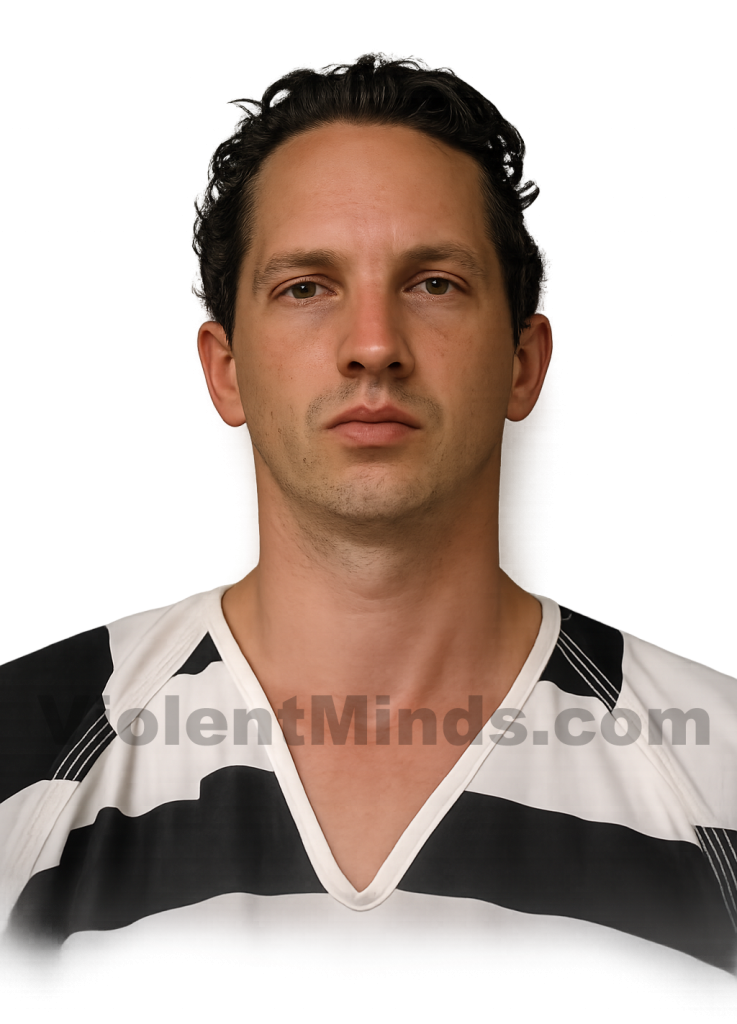
Digitally enhanced and re-rendered portrait of Israel Keyes, an American serial killer known as the “Alaskan Contractor.” Keyes carried out a series of meticulously planned murders across multiple states, using hidden caches of weapons and supplies to evade detection for years. He was taken into federal custody in 2012 following the abduction and murder of Samantha Koenig in Anchorage, Alaska, where the original booking photograph was produced during official processing.
By day, Israel Keyes looked like the kind of man you trust with your front door keys. He was a quiet Alaskan contractor, a devoted father who took his daughter camping and worked jobs in the community, blending into the background so completely that no one guessed what he was really doing with his frequent solo trips around the United States. By night – and often thousands of miles from home – he became something else entirely. Keyes stalked strangers in unfamiliar cities, dug up “kill kits” he had buried years earlier, and abducted, raped, and murdered people who had never seen him before that night. He studied other killers to sharpen his own methods, traveled specifically to kill, and bragged that “there is no one who knows me or who has ever known me, who knows anything about me really.”
When he was finally arrested in 2012 after abducting 18‑year‑old Anchorage barista Samantha Koenig, investigators realized they were dealing with a very different kind of American serial killer. He confessed to at least three murders that could be firmly tied to him and hinted at many more – possibly ten or eleven victims in total, spread across the country over more than a decade. The FBI would later describe him as one of the most meticulous, mobile, and deliberately anonymous serial offenders they had ever seen.
Early Life and Beliefs
Israel Keyes was born on January 7, 1978, in Utah and grew up largely in isolated, rural environments in Washington state, raised in a strict, fringe religious setting and homeschooled alongside numerous siblings. His parents were intensely anti‑government and moved the family off the grid for periods, living in remote areas with minimal outside contact. As a boy and teenager, he developed a fascination with weapons, hunting, and cruelty to animals that stood out even in a rough, survivalist context.
According to later investigative summaries and profiler commentary, Keyes showed early signs of conduct‑disordered behavior: he admitted in interviews to breaking into houses, setting fires, and harming animals for amusement. He also gravitated toward violent, taboo fantasies. At the same time, the ideological world he inhabited reinforced an “us versus them” mentality – distrust of institutions, contempt for outsiders, and a strong sense that he and his family were separate from mainstream social rules. That combination – early sadistic behavior, isolation, and a belief system that devalues the “outside world” – is a familiar mix in the developmental histories of highly predatory offenders.
As a young adult, Keyes served in the U.S. Army from 1998 to 2001, stationed at Fort Lewis in Washington, Fort Hood in Texas, and for a time in Egypt. In the military he was described as functional and competent, with no obvious disciplinary record that hinted at what he was becoming. Service provided structure, stability, and skills – particularly around weapons and planning – that he later folded into his private fantasies. When he left the Army, he carried with him not only training and confidence but also a reinforced capacity to compartmentalize: to be one person in public and another entirely in his own mind.
Double Life in Alaska
Eventually, Keyes settled in Anchorage, Alaska, started a construction business, and lived with a long‑term partner and their daughter. To neighbors and clients he appeared responsible, polite, and reliable. He worked jobs, coached his image carefully, and played the role of engaged father. That normalcy was not a mask in the theatrical sense; it was part of his identity. But alongside it, he cultivated a second life built on secrecy, risk, and control.
He traveled frequently within the United States, ostensibly for vacations, family visits, or work. These trips became the backbone of his offending pattern. Unlike more impulsive killers who work their own neighborhoods, Keyes went out of his way to kill far from home. He would fly into one city, rent a car, drive hundreds of miles to another region, and then hunt for victims in communities with no obvious tie to him. This mobility made him extremely difficult to connect to any one crime scene and gave him the psychological thrill of outsmarting both his victims and law enforcement.
Investigators later uncovered a disturbing detail: Keyes didn’t just travel to kill; he prepared for those murders years in advance. He buried “kill kits” – sealed five‑gallon buckets containing guns, ammunition, cash, zip ties, and tools – in remote spots across the country, including locations in New York and Alaska. When he was ready to offend, he would retrieve a kit, commit the crime, and then move on, sometimes re‑burying or relocating the materials for future use. The level of planning involved reflects not only careful operational thinking but also a long‑running, steady internal commitment to homicide as a preferred form of gratification.
Modus Operandi and Kill Kits
Keyes’ most notorious murders illustrate a core pattern: meticulous preparation, blitz‑style abductions, and a fusion of sexual violence with absolute control.
In February 2012, he targeted Samantha Koenig, an 18‑year‑old barista working alone at a coffee kiosk in Anchorage. Surveillance footage later showed him approaching the stand near closing, ordering coffee, then pulling a gun and forcing her to leave with him. Despite her attempts to flee, he subdued her, took her to his truck, then to his home. There he raped and sodomized her, strangled her with a rope, and left her body in a shed on his property – before departing on a pre‑booked cruise with his family from New Orleans. The juxtaposition is stark: one day he is torturing and murdering a teenager; days later he is on vacation, taking family photos.
When he returned to Anchorage, he went back to the shed, sexually assaulted Koenig’s corpse, then staged it to create the illusion she was still alive. He applied makeup, sewed her eyes open with fishing line, and photographed her holding a newspaper dated weeks after her actual death, using the image to demand ransom. This sequence shows not only extreme callousness and sadism but also a willingness to interact with the body post‑mortem in a way that suggests necrophilic undertones. The corpse became both a sexual object and a prop in a psychological game with her family and the authorities.
His known 2011 murders of Bill and Lorraine Currier in Vermont followed a different but equally chilling script. He flew into Chicago, drove over a thousand miles to Essex, Vermont, and then selected the Curriers’ home because they had no children, no dog, and an attached garage – features that reduced the likelihood of interference. He broke into their house at night, forced them from their bedroom at gunpoint, bound them with zip ties, and transported them to an abandoned farmhouse he had previously scouted. There he separated them, shot Bill, raped Lorraine, and then killed her before disposing of their bodies in a way that to this day has prevented their remains from being found. As in other cases, he relied on pre‑buried weapons and gear, then left the area, confident the crime could not easily be traced back to him.
Across his known and suspected offenses, certain themes repeat. He avoids victims with strong, obvious protective factors: no dogs, no children in the home, isolated properties when possible. He uses surprise, weapons, and restraints to gain immediate control, minimizing struggle and noise. He removes victims from their original locations to secondary sites, often abandoned structures or remote outdoor areas he has already identified, which gives him time and privacy to do what he wants. And he almost never kills close to home, preferring to strike in states where he has no apparent connection, then vanish. This travel‑based strategy, supported by kill kits and careful victim selection, is part of what makes Keyes so unusual within the broader serial‑killer landscape.
Psychology and Motivation
From his own statements and the pattern of his crimes, a psychological picture emerges of a man driven by control, sadism, and an almost abstract enjoyment of killing itself. In interviews, Keyes frequently framed his murders not as rooted in personal vendettas or clear‑cut grievances but as acts he committed because he wanted to and because he enjoyed the process of planning and executing them.
Investigators and profilers have highlighted several key traits. First, he exhibited classic psychopathic features: superficial charm, an ability to present as normal and even likable, profound lack of empathy, and a chilling emotional detachment when discussing his crimes. Those who reviewed his interrogation tapes noted how flat and unemotional he remained as he described abductions, rapes, and murders, talking about his victims as if they were items in a project plan rather than human beings.
Second, he displayed pronounced sadism and a need for domination. He engineered situations where he could exert total control over his victims – physically, psychologically, and logistically. The use of restraints, the relocation to secondary crime scenes, and the elaborate staging of Koenig’s corpse for the ransom photo all demonstrate a mind that finds pleasure in bending others entirely to his will, even when they are already dead.
Third, Keyes approached his crimes almost like a craft or discipline. He studied other serial killers, intentionally avoided their mistakes, and took pride in being hard to catch. He spoke about his offenses with the mindset of someone who had rules for himself: never kill close to home, never use the same method twice in the same place, never keep obvious trophies that could be linked back to him. That meta‑awareness of serial‑killer tropes – and his deliberate efforts to subvert them – contributed to the sense among investigators that they were dealing with “one of the most diabolical” offenders they had encountered.
Finally, there are hints of existential boredom and nihilism. Some analysts have suggested that Keyes killed partly to escape a crushing sense of emptiness. He built a conventional life, but inside it he remained profoundly detached. Murder, with all its planning, risk, and adrenaline, may have functioned as his only authentic source of stimulation. That fits with his own comments about enjoying not just the act itself but also the cat‑and‑mouse game with law enforcement – using Koenig’s debit card across multiple states after her death, for example, knowing that police would be tracking those withdrawals.
Victimology and Unknown Count
One of the most disturbing aspects of the Israel Keyes case is that the full number and identity of his victims remain unknown. During his interrogations, he hinted at at least eleven murders, possibly more, committed between roughly 2001 and 2012 across multiple states. The FBI has publicly confirmed only three homicides – Koenig and the Curriers – but believes there were many others, including a likely victim on the East Coast whose body he said he buried near Tupper Lake, New York, and other possible victims linked to his travels and buried caches.
Unlike offenders who stick to a narrow victim type, Keyes’ selection appears more opportunistic within his own parameters of control and risk. His known victims include a teenage barista grabbed from her workplace and a middle‑aged married couple taken from their home; he is also suspected in at least one case involving a woman abducted from the East Coast and possibly other single victims encountered on the road. What ties them together is not demographic profile but situational vulnerability: isolated locations, predictable routines, and limited immediate protection.
The uncertainty around his victim count is not simply an academic problem. It reflects how effective his methods were at erasing links between crimes. By traveling to kill, using pre‑buried tools, disposing of bodies in obscure locations, and attacking people with no prior connection to him, he created cases that, on paper, looked like isolated disappearances or unsolved homicides with no obvious suspect. That is why, years after his death, the FBI continues to release timelines, interviews, and interactive maps, hoping that someone will connect a missing person or unsolved case to one of his trips or caches.
Interview Games and Suicide
Once in custody, Keyes treated his interrogations as another arena for control. He drip‑fed information to investigators, trading details about murders for promises regarding media blackout and the timing of his execution. He made it clear he did not want to spend years on death row, telling agents he preferred a quick resolution and threatening that if they did not move fast he would stop talking.
Throughout these sessions, he remained guarded, often hinting at more victims but refusing to provide names, locations, or specifics unless it suited him. When shown a photograph of possible victim Debra Feldman, for instance, he paused, acknowledged something, and then said he did not want to talk about her “yet.” That push‑pull dynamic allowed him to maintain a sense of power even while physically confined, knowing that he controlled the answers families and investigators desperately wanted.
In December 2012, before his case could go to trial, Keyes killed himself in his jail cell in Anchorage by cutting his wrists and strangling himself, leaving behind a bizarre, rambling note filled with dark, poetic imagery but no clear confessions or victim list. With that act, he effectively froze the investigation in an incomplete state. The families of his known victims were denied the opportunity to see him face a verdict, and the families of suspected victims were denied the clearest chance they would ever have of getting answers. From a behavioral perspective, the suicide is consistent with his overall pattern: he set the terms, controlled the narrative as much as possible, and chose the moment when he exited the stage.
Profiler’s Take
Israel Keyes represents a particularly unnerving evolution in the modern American serial killer. He did not seek fame, taunt police through the press, or cultivate a public persona like some earlier offenders. Instead, he built anonymity into his method, moving silently across the map, burying his tools in advance, and choosing victims who had no idea he existed until the moment he attacked.
Psychologically, he embodies a cold synthesis of psychopathy, sadism, and strategic thinking. His pleasure came not only from the acts of abduction, rape, and murder but also from the planning, the clean execution, and the knowledge that he had “gotten away with it” as he returned to his role as father and contractor. He is a case study in how dangerous a killer can be when he is willing to live without recognition, treat murder as a disciplined craft, and let the rest of his life serve as perfect camouflage.
FOR READERS FASCINATED BY CRIMINAL MINDS
From the creators of Violent Minds comes Murder.net - a psychological cyber-thriller about control, fear, and obsession, where a killer streams his murders online to paying subscribers. How far would you go to stop a monster?
Get The Book
