Mark James Robert Essex – The “New Orleans Sniper”
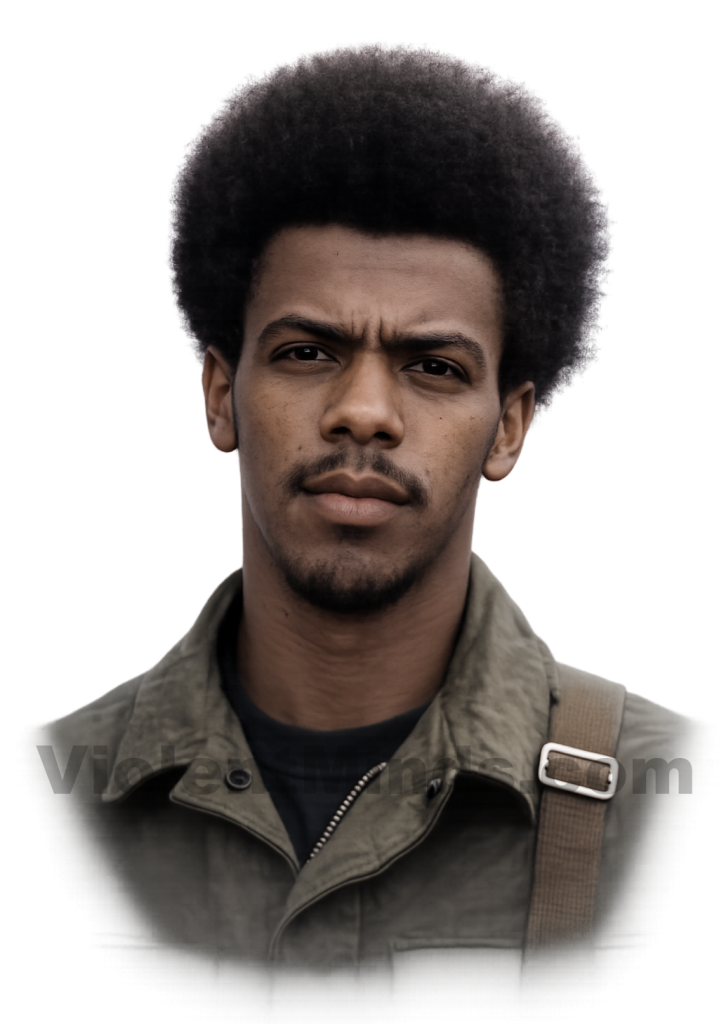
Introduction
Mark James Robert Essex (1949–1973) was a 23‑year‑old former U.S. Navy sailor and self‑styled Black militant best known as the “New Orleans Sniper.” Between December 31, 1972 and January 7, 1973, he killed nine people (including five police officers) and wounded twelve others in two attacks, culminating in a rooftop siege at the Howard Johnson’s Motor Lodge in downtown New Orleans.
Early life and background
Essex was born August 12, 1949, in Emporia, Kansas, the second of five children in a close‑knit, religious, working‑class family. His father worked as a foreman in a meat‑packing plant and his mother with disadvantaged preschool‑age children, and Essex grew up in a small town that prided itself on relatively harmonious race relations compared with the Deep South. Friends and family later described him as a “happy‑go‑lucky” boy and an average student with no serious behavioral problems, a portrait sharply at odds with his later notoriety.
In 1969 he enlisted in the U.S. Navy and initially performed well, training as a dental technician. However, he reported experiencing pervasive racism – racial slurs, unequal treatment, and a hostile climate on base – which contrasted with his earlier experiences in Emporia and began to radicalize his thinking about white people and American institutions.
Criminal history
Essex’s pre‑spree legal record was limited. While in the Navy he was disciplined for going absent without leave after a confrontation with a white non‑commissioned officer who made a racist remark. A Navy psychiatrist who evaluated him around this time described an “immature personality” and noted that although Essex denied suicidal intent, he hinted he “might do something” if he did not get what he wanted – language later seen as ominous in retrospect.
He was given a general discharge for “unsuitability” in early 1971 and returned to Emporia, where his family noticed a marked personality change: he became withdrawn, bitter, and increasingly hostile toward whites. There is no record of serious civilian criminal charges between his discharge and the New Orleans shootings, making his later violence appear, on paper, as a sudden escalation rather than the culmination of a long criminal career.
Spree killings
After leaving the Navy, Essex immersed himself in Black militant literature and rhetoric, including the writings of Black Panther leaders, and befriended activists who reinforced his belief that armed struggle against racist institutions was justified. He began practicing with firearms and adopted an increasingly separatist worldview, expressing hatred of white people and police and talking about violent retribution for racism and police brutality.
In 1972 he moved to New Orleans, living in cheap rooms in the Central City area and briefly attending an African studies course while enrolled in a federally funded vending‑machine repair program. Observing deep poverty and tense police–community relations in Black neighborhoods, he grew more despondent and angry; by mid‑1972 he was leading an isolated existence, battling depression, and focusing on plans to “strike back.”
December 31, 1972: First attack
On the night of December 31, 1972, Essex carried out his first shooting attack, targeting New Orleans Police Department (NOPD) facilities and officers. Armed with a .44‑caliber semi‑automatic rifle, he fired on the NOPD central lockup and later ambushed Officers Edwin Hosli Sr. and Harold Blappert outside the Burkart Manufacturing Building after setting off an alarm by breaking in.
He shot Officer Hosli in the back as Hosli retrieved his police dog; Hosli later died of his injuries, while Blappert was wounded but survived. In this first incident, Essex demonstrated an emerging pattern: attacks on police infrastructure, use of surprise and darkness, and a clear intent to kill uniformed officers.
January 7, 1973: Howard Johnson’s siege
On the morning of January 7, 1973, Essex launched his main assault. He first shot and severely wounded the owner of Joe’s Grocery, then carjacked a Black motorist, telling him, “I don’t want to kill you, but I’ll kill you too!” – indicating his focus was on white targets. He drove to the Howard Johnson’s Motor Lodge across from New Orleans City Hall, entered the building, and began shooting and setting fires on upper floors to create confusion.
Inside the hotel he killed the general manager, Frank Schneider, Schneider’s wife, and a young assistant manager, as well as a hotel guest, while wounding others as he moved through hallways and rooms. He then took up sniper positions on upper levels and the roof, firing down at police and firefighters responding to the blaze, as well as at bystanders in the surrounding plazas and offices.
Across several hours he shot multiple officers: he fatally wounded Officer Paul Persigo, traffic officer Phillip Coleman, and other responding personnel, and wounded several more, including officers who had taken positions in nearby buildings to return fire. He repeatedly shifted vantage points, using the height of the hotel to dominate the area and pick off targets who exposed themselves.
System failure
Essex’s pathway highlights difficulties institutions had in recognizing and responding to politically framed, lone‑actor violence in the early 1970s. The Navy recognized behavioral problems and recorded his statements that he “might do something,” yet opted for a general discharge without apparent follow‑up on his growing grievance and hostility. No systematic mechanism existed to flag discharged service members with emerging extremist beliefs for mental‑health intervention or ongoing risk assessment.
In New Orleans, Essex lived largely under the radar – moving between cheap apartments, sporadically attending classes and training programs, and socializing mainly with a small circle of militants – so there was little formal system engagement before his attacks. More broadly, local and federal agencies were already preoccupied with organized groups like the Black Panthers; a solitary ex‑sailor with radical views did not fit established threat models until he began shooting.
The tactical response at Howard Johnson’s also exposed operational gaps: officers initially lacked training and equipment for high‑angle sniper situations in urban high‑rises, and multiple officers were wounded or killed while trying to assist colleagues under fire. The extraordinary step of using a Marine helicopter for rooftop engagement, while ultimately decisive, underscored how unprepared local agencies were for such a scenario.
Psychological profile
Accounts from family, friends, Navy records, and later historians suggest a transformation from a sociable, average Midwestern youth to a deeply embittered, ideologically radicalized killer. Navy experiences of racism – and his perception that grievances were dismissed by a white‑dominated hierarchy – appear pivotal: he moved from disappointment to global conclusions that “all whites” and “all cops” were enemies.
Essex’s writings and statements show:
- Grievance and persecution: A narrative that he and Black people collectively were under violent assault by racist institutions, particularly police and the military.
- Black supremacist ideology: Adoption of black nationalist and black supremacist rhetoric, framing killing white people and police as justified revolutionary violence.
- Dehumanization and mission: Repeated expressions of intent to kill “as many white people and cops” as possible, suggesting a mission‑oriented mindset rather than personal vendetta against specific individuals.
The Navy psychiatrist’s diagnosis of “immature personality” likely reflected poor coping skills, impulsivity, and difficulty managing frustration, traits that – combined with ideological rigidification and depressive isolation – created a high‑risk mix. By late 1972 he was living alone, brooding on perceived injustices, rehearsing violent fantasies, and preparing tactically, which fits a grievance‑driven lone‑actor profile similar to later extremist shooters.
Behaviorally, his attacks were semi‑organized: he selected symbolic targets (police, downtown hotel across from City Hall), used arson as a diversion, and exploited elevated positions to maximize casualties and delay his own death. His repeated willingness to re‑expose himself to fire and the symbolic nature of his rooftop stand suggest he anticipated dying in the confrontation and viewed it as martyrdom.
Aftermath and legacy
The Howard Johnson’s siege ended only after New Orleans police, assisted by a Marine Corps helicopter piloted by Lt. Col. Charles Pitman, saturated Essex’s rooftop position with gunfire. As officers closed in, Essex broke from a cubicle and charged, firing; police on surrounding rooftops and the helicopter’s door gunners unleashed a barrage that struck him more than 200 times, killing him instantly with only two rounds left in his rifle – an act interpreted as a form of symbolic suicide charge.
Ballistics linked his weapon to both the New Year’s Eve and Howard Johnson’s shootings, confirming he was responsible for the entire series of attacks. In total, Essex shot 21 people, nine of whom died, including five law‑enforcement officers; all but one of the victims were white or Hispanic.
The incident forced major changes in police tactics nationwide, particularly around active‑shooter response, rooftop snipers, and coordination with military aviation assets. Essex’s story continues to be cited in discussions of racialized political violence and lone‑actor extremism, illustrating how personal experiences of discrimination, untreated psychological distress, and militant ideology can converge into short, devastating campaigns of targeted mass violence.
FOR READERS FASCINATED BY CRIMINAL MINDS
From the creators of Violent Minds comes Murder.net - a psychological cyber-thriller about control, fear, and obsession, where a killer streams his murders online to paying subscribers. How far would you go to stop a monster?
Get The Book
