Leslie Louise Van Houten – Manson Family Killer
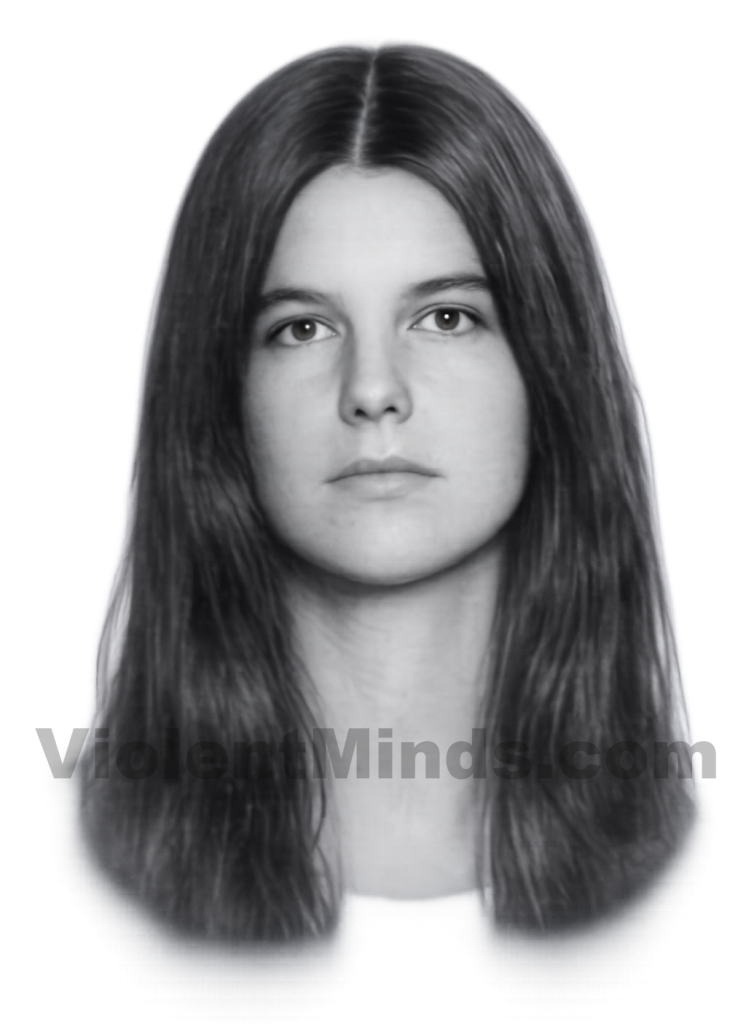
Digitally enhanced and re-rendered portrait of Leslie Louise Van Houten, based on an early booking photograph taken following her arrest in connection with the 1969 LaBianca murders. Van Houten was a member of the Manson Family and participated in the killings carried out under Charles Manson’s direction.
Introduction
Leslie Louise Van Houten went from popular Southern California teenager to the youngest Manson Family member convicted of murder, participating in the LaBianca killings at 19 and then spending more than five decades in prison before finally gaining parole in 2023 and completing it in 2025. Her trajectory – early family fracture, heavy LSD use, immersion in Manson’s control, and later decades of treatment, education, and advocacy – makes her one of the most contested examples of whether a person who committed notorious crimes can ever be considered rehabilitated.
Identity And Aliases
- Full Name – Leslie Louise Van Houten.
- Known Aliases – “Lulu,” “Louella Alexandria,” “Linda Sue Owens,” “Leslie Marie Sankston,” among others used while with the Family.
- Role In The Manson Family – Youngest of the convicted killers, direct participant in the LaBianca murders but not present at Cielo Drive; often portrayed as more emotionally conflicted and more salvageable than some of her co‑defendants.
Early Life and Family Background
Van Houten was born August 23, 1949, in Los Angeles, California, into a white, middle‑class, Protestant family that projected a conventional stability from the outside. Her parents divorced when she was 14, a rupture she experienced as deeply destabilizing; in its wake she began smoking marijuana and, by about 15, experimenting heavily with LSD and other psychedelics.
Before her drug use escalated, she had been a homecoming queen, a good student, and a popular teenager at Monrovia High School – someone whose early life fit a “California success” template rather than a future‑murderer narrative. At 17 she ran away with her boyfriend to live in a shack and became pregnant, only for her mother to force her to undergo an abortion and bury the fetus in their backyard, an experience that left a lasting emotional scar and further poisoned their relationship.
Adolescent Drift and Vulnerabilities
After the abortion and intensifying conflict with her mother, Van Houten’s sense of self fractured. She immersed herself more fully in drugs and the era’s hippie culture, defined increasingly by experimentation and anti‑establishment attitudes. She still returned to finish high school, graduating in 1967, but the girl who walked across the stage was already psychologically distant from her earlier, grounded self.
In the late 1960s she moved into communes and embraced a free‑love, LSD‑suffused lifestyle, drifting from her family and conventional ambitions. Friends and later evaluators have framed this period as a search for identity and belonging after the twin shocks of parental divorce and coerced abortion – needs that would later make her highly susceptible to an older man promising spiritual meaning and community.
Meeting Charles Manson and Joining The Family
Van Houten met Catherine “Gypsy” Share at a commune, a charismatic young woman who became her portal into Charles Manson’s world. Share introduced her to the Manson Family in late 1968, by which point Van Houten was already heavily using LSD and primed for the group’s blend of drugs, music, and apocalyptic talk.
By the fall of 1968 she had moved to Spahn Ranch, becoming part of the inner circle and quickly adopting Manson’s language and values. She later described herself as “infatuated” with Manson, saying she believed he had answers she lacked and that she let him overpower her “individual thinking,” surrendering autonomy in exchange for a sense of purpose.
Role Within The Manson Family
Within the Family, Van Houten took on the persona of “Lulu,” a compliant, eager follower who helped with chores, group life, and sexual availability while absorbing Manson’s teachings about race war and cosmic destiny. Barbara Hoyt later said Van Houten was considered something of a “leader” among the girls, indicating that she wasn’t simply passive but helped transmit group norms and enforce the internal culture on newer women.
Manson and his lieutenants saw her as intelligent, emotionally pliable, and highly influenceable, especially under the constant haze of LSD and group pressure. That combination – youth, psychological pliability, and eagerness to belong – would prove lethal when Manson decided it was time to move from rhetoric to murder.
Escalation To Violence
By summer 1969, Van Houten had spent months in a closed environment saturated with psychedelics, Manson’s reinterpretation of Beatles lyrics, and repeated predictions of an imminent “Helter Skelter” race war. Her world had shrunk to the Family and its needs; empathy for outsiders was eroded by an us‑versus‑them narrative in which wealthy, “pig” society became both enemy and target.
Although she was not involved in the July 1969 murder of Gary Hinman or the August 8–9 Tate killings, those events further normalized homicide inside the group and demonstrated that Manson’s violent talk was no longer hypothetical. When he tapped her for the next mission, she did not refuse.
The LaBianca Murders
On the night of August 9–10, 1969, Manson led a group – including Van Houten, Tex Watson, Patricia Krenwinkel, Linda Kasabian, and others – into a Los Angeles neighborhood, ultimately targeting the home of wealthy grocer Leno LaBianca and his wife Rosemary. Manson and Watson entered first, tied up the couple, and reassured them it was a robbery before Manson left, leaving Watson, Van Houten, and Krenwinkel to carry out the killings.
Inside, Watson attacked Leno while Krenwinkel and Van Houten focused on Rosemary. Van Houten later admitted that she held Rosemary down while she was being stabbed and then, after Rosemary was either dead or dying, stabbed her approximately 14–16 times in the lower back and buttocks with a knife. She has maintained that Rosemary was already dead when she inflicted her wounds, but courts and parole boards have long viewed that distinction as legally and morally irrelevant given her active participation in the murder.
Arrest, Trials, and Convictions
Van Houten was arrested in November 1969 in connection with the LaBianca murders. In the original 1970–71 Manson trial, she was tried alongside Manson, Susan Atkins, and Patricia Krenwinkel and was convicted of two counts of first‑degree murder and one count of conspiracy on March 29, 1971. At 21, she became the youngest woman ever sentenced to death in California.
During the penalty phase, she attempted to take more blame onto herself, at one point claiming involvement in a killing she had not committed in an effort to exonerate Manson, behavior that a psychiatrist described as reflecting both grandiosity and deep psychological disturbance. Her death sentence, like the others, was commuted to life imprisonment with the possibility of parole when California’s death penalty was struck down in 1972.
Her original conviction was overturned in 1976 because her trial attorney, Ronald Hughes, had disappeared and died during the proceedings, depriving her of effective counsel. A second trial in 1977 ended with a hung jury, but at a third trial in 1978 she was again convicted of the LaBianca murders and conspiracy and sentenced to seven years to life.
Prison Life, Treatment, and Rehabilitation
Van Houten spent more than five decades in custody, primarily at the California Institution for Women in Chino. Over the years she completed college degrees, participated in extensive psychotherapy, and became involved in a range of self‑help, substance‑abuse, and victim‑awareness programs that clinicians later cited as evidence of deep rehabilitation.
Therapists and evaluators described her as insightful, remorseful, and low‑risk for future violence, noting that her crimes occurred in a highly specific, cultic context that no longer exists in her life. She worked with younger inmates, facilitated groups, and was often held up by prison staff as a model prisoner who had done everything the system asked of her and more.
Psychological Profile and Violent Mindset
Van Houten’s case is often cited in forensic and cult‑psychology circles as an example of how several risk factors can converge: adolescent trauma (divorce, coerced abortion), identity diffusion, heavy hallucinogen use, and recruitment into a tightly controlled, charismatic group. Under Manson’s influence and chronic LSD exposure, she came to see him as a messianic figure and herself as a willing instrument of his will, allowing her to override her prior moral code.
At the time of the LaBianca murders, she appeared to be operating from a fusion of group loyalty, altered consciousness, and a desperate need to belong – all of which supported a mindset in which stabbing a stranger could be reframed as participation in a larger, almost spiritual mission. In later years, she described herself as “devastated” by her actions, saying she had “allowed evil” into her life and that she had spent decades trying to understand how she became someone capable of that night.
Remorse, Insight, and Changing Narrative
Across more than 20 parole hearings, Van Houten gave increasingly detailed accounts of how she came under Manson’s control, how LSD and the closed group environment broke down her individual thinking, and how she now understood the enormity of what she had done. The state appeals court that finally ordered her release noted that she had “given a detailed accounting of the circumstances” leading to the crimes and had demonstrated “extraordinary rehabilitative efforts.”
She consistently expressed regret not only for the murders but for failing to leave Manson earlier, acknowledging that she had opportunities to walk away but chose not to. For supporters, this long‑term, specific, and introspective remorse distinguishes her from Manson and some other followers who were slower to accept responsibility or continued to minimize their agency.
Parole Battles and Release
Van Houten first became eligible for parole in the late 1970s but was denied repeatedly – more than 20 times – as boards and governors focused on the horrific nature of the crimes and the political and emotional weight attached to anything related to Manson. In her last five hearings, the parole board actually recommended release, but California governors (Jerry Brown and Gavin Newsom) reversed each grant, arguing she still posed an “unreasonable risk” or that her insight was insufficient relative to the crime’s gravity.
In May 2023, a California appellate court ruled 2–1 that there was no longer a legal basis to deny her parole, finding that the governor’s reversals were not supported by “some evidence” of current dangerousness given her age, record, and extensive rehabilitation. The ruling effectively cleared the way for her release over the governor’s objections.
Life On Parole and Discharge
On July 11, 2023, at age 73, Leslie Van Houten walked out of the California Institution for Women and was taken to a transitional living facility under state supervision. Her parole term was set at a maximum of three years, with an initial review after the first year to determine whether early discharge was appropriate.
On August 7, 2025, she was formally discharged from parole, ending state supervision and concluding her sentence after roughly 53 years in custody and two years on supervised release. Details of her current whereabouts are confidential, but those close to the process have emphasized that she faces a radically changed world and significant challenges in adjusting to everyday tasks like using the internet, shopping, and living anonymously after decades of notoriety.
Ongoing Debate And Legacy
Van Houten’s release continues to provoke intense debate. For victims’ families, no amount of rehabilitation can outweigh her role in the LaBianca murders, and her freedom is experienced as a reopening of wounds that had never fully healed. For many criminologists, mental‑health professionals, and prison‑reform advocates, she represents one of the clearest cases that a person can commit a horrific crime under cultic influence and, decades later, present as genuinely rehabilitated and low risk.
Her story sits at the intersection of responsibility and persuasion: she is both someone who made catastrophic choices that destroyed lives and someone who spent most of her life trying to understand, atone for, and grow beyond those choices. She offers a rare chance to examine what “rehabilitation” can look like when the original crime is among the most infamous of an era.
FOR READERS FASCINATED BY CRIMINAL MINDS
From the creators of Violent Minds comes Murder.net - a psychological cyber-thriller about control, fear, and obsession, where a killer streams his murders online to paying subscribers. How far would you go to stop a monster?
Get The Book
