Patricia Dianne Krenwinkel – Manson Family Killer
Introduction
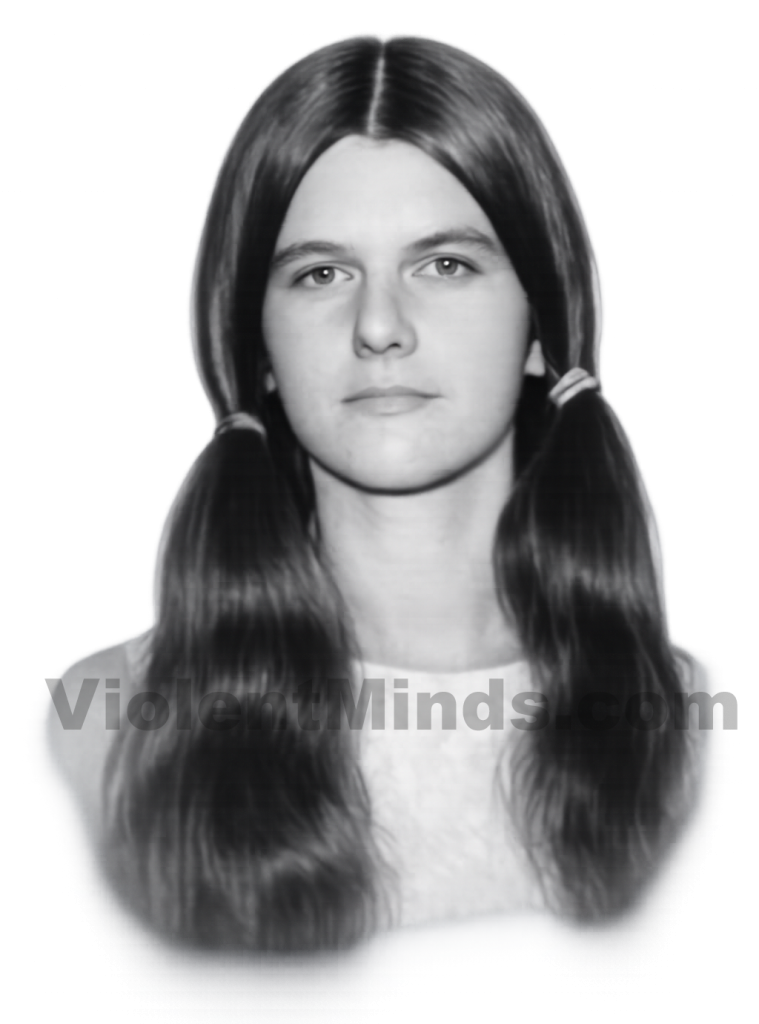
Patricia Dianne Krenwinkel was one of Charles Manson’s most committed followers, directly involved in the Tate murders and the LaBianca killings, and later notorious for describing repeated stabbing as feeling like “nothing.” Once a shy young woman who briefly considered becoming a nun, she has since become the longest‑incarcerated woman in California, repeatedly denied parole despite decades of claimed rehabilitation.
Identity And Aliases
- Full Name – Patricia Dianne Krenwinkel.
- Known Aliases – “Katie” within the Family; also “Big Patty,” “Yellow,” “Marnie Reeves,” and “Mary Ann Scott.”
- Role In The Manson Family – Core female follower, direct participant in the Tate–LaBianca murders, often portrayed as one of Manson’s most loyal and violent adherents.
Early Life And Family Background
Krenwinkel was born December 3, 1947, in Los Angeles, California, the quiet daughter of an insurance‑salesman father and a stay‑at‑home mother. Her parents divorced when she was 17, and she remained in Los Angeles with her father until graduating from Westchester High School, a period marked by low self‑esteem, social awkwardness, and a sense of not fitting in.
A practicing Catholic, she taught catechism classes and seriously considered becoming a nun, reflecting an early identity organized around service and religious rules rather than rebellion. She enrolled at Spring Hill College, a Jesuit school in Mobile, Alabama, to study and continue her religious path, but she dropped out after one semester and returned to California, moving in with her half‑sister in Manhattan Beach and taking an office job as a processing clerk.
Vulnerabilities and Drift
Throughout adolescence, Krenwinkel struggled with body image, teasing, and chronic insecurity, reporting that she felt unattractive and invisible to peers. Those long‑standing self‑doubts, combined with familial fracture from the divorce and the abrupt derailment of her religious college plans, left her searching for validation and belonging as she entered her twenties.
Her return to Southern California placed her at the intersection of late‑1960s beach culture and emerging counterculture scenes, where traditional Catholic norms clashed with new models of freedom, drugs, and communal living. In that context, a charismatic outsider promising unconditional acceptance and “family” had enormous psychological leverage.
Meeting Charles Manson and Joining The Family
In 1967, while living with her half‑sister in Manhattan Beach, Krenwinkel met Charles Manson along with Mary Brunner and Lynette “Squeaky” Fromme. In later interviews, she said she had sex with Manson the first night they met and that he was the first person who ever told her she was beautiful – an experience she described as profoundly disarming and intoxicating for someone who had always felt unwanted.
Mesmerized by his attention and apocalyptic philosophy, she left behind her apartment, car, job, and last paycheck to follow him to San Francisco and, later, to the communes and ranches that became the Manson Family’s base. In that closed environment, she shed the aspiring‑nun persona and reinvented herself as “Katie,” a devoted adherent whose new worth came from obedience to Manson and the group.
Role Within The Manson Family
Within the Family, Krenwinkel was a loyal, dependable follower who acted as both caretaker and enforcer – helping with chores, errands, and group logistics, but also willing to carry out violent orders. Manson’s system rewarded her compliance and framed brutality as proof of commitment to Helter Skelter, transforming her from shy outsider into a woman who believed she was finally important and necessary.
Other members later noted her unwavering loyalty and readiness to back Manson’s directives, even when they involved violence. This combination of emotional dependency and operational reliability positioned her as one of the key women Manson trusted for high‑risk missions.
Escalation to Violence
By 1969, Krenwinkel was fully immersed in Manson’s worldview, which fused racial apocalypse, Beatles lyrics, and his own prison‑hardened philosophy into a prophecy of imminent chaos. As the Family moved from vehicle thefts and drug rip‑offs toward more serious crimes, her psychological boundaries eroded; empathy for outsiders was reframed as weakness, and killing became an act of spiritual warfare.
When Manson decided that murders were needed to jump‑start Helter Skelter and send a coded message to society, Krenwinkel did not refuse or hesitate in any way that stopped her participation. Her long‑standing hunger to be loved and valued now expressed itself through a willingness to kill for the group.
The Tate Murders
On the night of August 8–9, 1969, Manson directed Tex Watson to take Krenwinkel, Susan Atkins, and Linda Kasabian to 10050 Cielo Drive and “destroy everyone” inside. At the house, Krenwinkel helped round up the occupants – Sharon Tate, Abigail Folger, Jay Sebring, and Wojciech Frykowski – after Watson shot student Steven Parent in his car outside the property.
She chased Abigail Folger onto the lawn as Folger tried to flee, tackled her, and stabbed her repeatedly; Folger suffered dozens of stab wounds in total, from both Krenwinkel and Watson. At trial, when asked about the killing, Krenwinkel said, “I stabbed her and I kept stabbing her,” adding that it felt like “nothing” and “it was just there, and it was right” – a chilling glimpse into the level of moral disengagement she had reached.
The LaBianca Murders
The following night, August 9–10, 1969, Krenwinkel accompanied Manson, Watson, Leslie Van Houten, and others into a Los Feliz neighborhood, where they targeted the home of Leno and Rosemary LaBianca. After Manson and Watson entered first, tied the couple up, and reassured them it was only a robbery, Manson left the house and handed control to his followers.
Inside, Krenwinkel participated in the torture and murder of the LaBiancas, stabbing Rosemary and then returning to the crime scene to write messages like “DEATH TO PIGS” and “HEALTER SKELTER” in blood on the walls and refrigerator. The combination of personal violence and symbolic graffiti demonstrated how fully she had embraced Manson’s fusion of murder and theatrical terror.
Arrest, Extradition, and Trial
In the aftermath of the murders and the Family’s dispersal from Spahn Ranch, Krenwinkel fled to Alabama, where she stayed with relatives and briefly tried to construct a new life while the investigation closed in. She was arrested there on December 1, 1969, indicted the next day for seven counts of first‑degree murder and one count of conspiracy, and initially fought extradition back to California, later claiming she feared Manson would have her killed.
In February 1970 she waived extradition and returned to Los Angeles, where she was tried alongside Charles Manson, Susan Atkins, and Leslie Van Houten in a nine‑month trial that captivated the country. She was convicted on all counts and sentenced to death, joining the other women on a newly built death row for female inmates in California.
Sentencing, Commutation, and Prison Life
Krenwinkel’s death sentence, like those of her co‑defendants, was commuted to life imprisonment with the possibility of parole after the California Supreme Court struck down the state’s death penalty statute in 1972. She has been incarcerated ever since, serving her sentence primarily at the California Institution for Women and becoming, following Susan Atkins’s death and Leslie Van Houten’s release, the state’s longest‑serving female prisoner.
Over decades behind bars, she obtained multiple college degrees, participated in self‑help and therapy programs, trained service dogs, and engaged in mentoring work with other incarcerated women—changes frequently cited in psychological evaluations and parole hearings as evidence of substantial rehabilitation. Yet these same reports also note ongoing “deficits in self‑awareness” and a “tendency to externalize blame” for her past actions.
Psychological Profile and Violent Mindset
Krenwinkel’s story highlights how chronic low self‑esteem, emotional neglect, and a desperate desire to be loved can make a person profoundly vulnerable to a charismatic, controlling leader. She has said that “it all comes from just a simple thing as just wanting to be loved,” describing how that need eclipsed her capacity to judge Manson’s demands and the crimes he ordered.
During the murders, her repeated stabbing and subsequent flat description of the act as feeling like “nothing” indicate a level of dissociation and moral numbing in which victims ceased to exist as fully human. In later interviews and parole testimony, she has spoken of spending decades in therapy “trying to locate that bottom that absolutely allowed me to feel nothing and be nothing and see myself as nothing,” suggesting belated insight into how self‑erasure preceded – and enabled – her violence.
Remorse, Insight, and Narrative
In recent years, Krenwinkel has presented herself as deeply remorseful, acknowledging that “countless” lives were shattered by the “path of destruction” she helped create. She now emphasizes accountability, saying she no longer wants to disappear into others’ expectations but to show who she is, even if people never forgive her.
Still, governors and some evaluators have questioned the depth and consistency of her insight, pointing to subtle ways she continues to externalize blame or frame herself primarily as a manipulated victim rather than a fully responsible perpetrator. That tension – between sincere remorse and residual self‑protection – sits at the heart of how the system and the public interpret her late‑life narrative.
Parole Hearings and Current Status
Krenwinkel has appeared before the parole board many times since first becoming eligible in the early 1980s, and she has been denied parole more often than Manson himself was before his death. In 2022, a parole panel recommended her release, but Governor Gavin Newsom reversed the decision, citing the gravity of her crimes and concerns about her remaining psychological risk.
In 2025 she was again recommended for parole, and again Newsom denied it, explicitly referencing a 2025 psychological report that praised her rehabilitation but concluded she still showed “deficits in self‑awareness” and a “tendency to externalize blame.” As of now, in her late seventies with chronic health issues, she remains incarcerated, officially judged to pose an “unreasonable danger to society” if released despite more than half a century behind bars.
FOR READERS FASCINATED BY CRIMINAL MINDS
From the creators of Violent Minds comes Murder.net - a psychological cyber-thriller about control, fear, and obsession, where a killer streams his murders online to paying subscribers. How far would you go to stop a monster?
Get The Book
